
Jakafi (ruxolitinib) for myelofibrosis
 Fact-checked by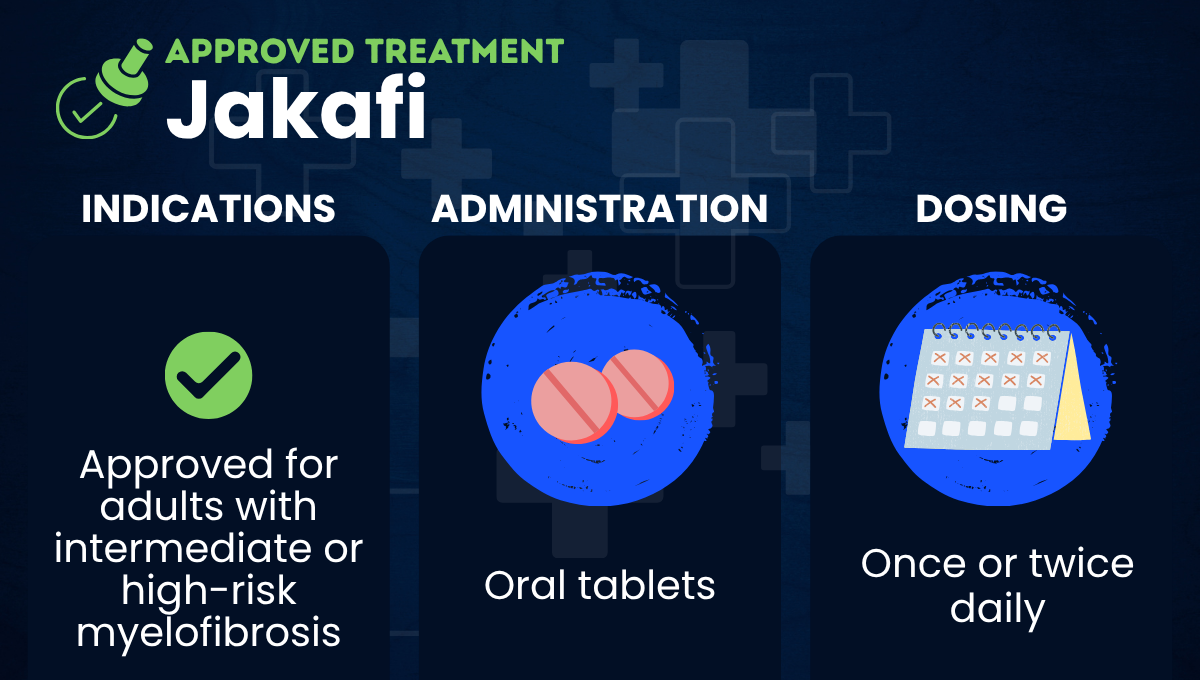
What is Jakafi for myelofibrosis?
Jakafi (ruxolitinib) is an oral therapy that’s approved to treat certain adults with intermediate- or high-risk myelofibrosis.
Myelofibrosis is a blood cancer in which abnormal blood cell production leads to inflammation and scarring in the bone marrow. It is generally associated with overaction of the JAK-STAT signaling pathway that’s involved in blood cell production.
Jakafi belongs to a class of therapies called JAK inhibitors that work to dampen this overactive signaling pathway. That helps reduce abnormal cell growth and ease related symptoms, such as an enlarged spleen, fatigue, and night sweats.
Taken in the form of oral tablets, Jakafi is marketed in the U.S. by Incyte and elsewhere by Novartis under the brand name Jakavi. An extended-release formulation, marketed in the U.S. under the brand name Jakafi XR, is also available. Both Jakafi and Jakafi XR are also approved for treating certain people with the blood disorder polycythemia vera (PV) and the post-transplant complication graft-versus-host disease.
Therapy snapshot
| Brand name | Jakafi, Jakafi XR |
| Chemical name | Ruxolitinib |
| Usage | Used to treat certain adults with myelofibrosis |
| Administration | Oral tablets or extended-release tablets |
Who with myelofibrosis can take Jakafi?
In the U.S., both Jakafi formulations are approved for adults with intermediate-risk or high-risk myelofibrosis. This includes primary myelofibrosis, as well as post-PV myelofibrosis and post-essential thrombocythemia myelofibrosis.
The medication is also approved in the European Union and Canada for treating disease-related symptoms in adults with myelofibrosis.
There are no contraindications for Jakafi’s use.
How is Jakafi administered in myelofibrosis?
Jakafi is administered as oral tablets, taken twice daily, with or without food. For people unable to swallow, the tablets can be suspended in about 40 mL of water and administered through a feeding tube.
Jakafi XR is available in the form of extended-release tablets, to be taken once daily, with or without food. The tablets should be swallowed whole, and not split, chewed, or crushed.
The recommended starting dose of both Jakafi and Jakafi XR is based on a person’s blood levels of platelets, the cell fragments involved in blood clotting:
- greater than 200 billion per liter: 20 mg twice daily for Jakafi, and 44 mg once daily for Jakafi XR
- 100 billion to 200 billion per liter: 15 mg twice daily for Jakafi, and 33 mg once daily for Jakafi XR
- 50 billion to 99 billion per liter: 5 mg twice daily for Jakafi, and 11 mg once daily for Jakafi XR
The dose is then individualized based on safety and effectiveness. For Jakafi, it can be increased as needed for efficacy to 10 mg twice daily for people with platelet counts less than 100 billion per liter and to 25 mg twice daily for people with higher platelet levels. Similarly, Jakafi XR doses can be increased to 22 mg once daily for people with platelet counts less than 100 billion per liter and to 55 mg once daily for people with higher platelet levels.
Blood counts will be monitored regularly during the dose adjustment phase, and thereafter as clinically indicated. If blood cell counts get too low, treatment may need to be modified or interrupted. When restarting treatment after a safety pause, a different dosing regimen may be required.
Doses may also need to be adjusted in patients who are taking other medications, and in those who have moderate to severe kidney impairments, kidney failure, or liver impairment.

Jakafi in myelofibrosis clinical trials
Jakafi’s approval for myelofibrosis was largely supported by two Phase 3 clinical trials, both involving adults with intermediate or high-risk myelofibrosis and an enlarged spleen:
- The COMFORT-1 trial (NCT00952289) enrolled 309 patients who did not respond sufficiently to or were not candidates for available treatments. The participants were randomly assigned to receive either Jakafi or a placebo. The results showed that 41.9% of people given Jakafi achieved at least a 35% reduction in spleen size after six months, compared with fewer than 1% of those on the placebo. Overall symptom burden was also reduced with the treatment.
- The COMFORT-2 trial (NCT00934544) was an open-label study involving 219 patients, who received either Jakafi or the best available therapy. These results showed that nearly 30% of Jakafi-treated patients achieved at least a 35% reduction in spleen size after nearly a year, compared with none in the standard care group.
Additional analyses demonstrated survival benefits with Jakafi relative to the comparator group in both studies.
The approval of Jakafi XR was backed by data from clinical trials of Jakafi, and a bioequivalence study showing that a single 55 mg tablet of Jakafi XR taken once daily delivers the same amount of ruxolitinib as a single 25 mg tablet of Jakafi taken twice daily.
Jakafi side effects
In people with myelofibrosis, the most common side effects of Jakafi include:
- thrombocytopenia
- anemia, or a lack of healthy red blood cells
- bruising
- dizziness
- headache
- diarrhea
The prescribing information for both therapy formulations also comes with warnings for potential serious side effects, which require careful monitoring of patients. Among these side effects are:
- low blood cell counts
- increased risk of serious infections, such as tuberculosis, herpes, the rare brain infection progressive multifocal leukoencephalopathy, and reactivation of the hepatitis B virus
- increased risk of non-melanoma skin cancer
- high levels of fats in the blood, including cholesterol
- major cardiovascular events, including a heart attack or stroke
- blood clot-related complications
- secondary cancers, especially in current or former smokers
If any of these occur, they should be treated as appropriate. In some cases, doses may need to be reduced or treatment interrupted. Jakafi and Jakafi XR should not be started in people with active serious infections.
Myelofibrosis symptoms could get suddenly worse when treatment is interrupted or discontinued. If that occurs, patients will receive supportive care, and reinitiation of Jakafi or Jakafi XR may be considered. When stopping Jakafi or Jakafi XR for reasons other than low blood cell counts, the dose should be gradually tapered.
Patients are also advised not to breastfeed while using the medication and for two weeks after the last dose.
Myelofibrosis News is strictly a news and information website about the disease. It does not provide medical advice, diagnosis, or treatment. This content is not intended to be a substitute for professional medical advice, diagnosis, or treatment. Always seek the advice of your physician or other qualified health provider with any questions you may have regarding a medical condition. Never disregard professional medical advice or delay in seeking it because of something you have read on this website.