
Combination therapy boosts spleen shrinkage in myelofibrosis trial
Analyses: It may also have greater effect on underlying disease than Jakafi alone
Written by |

A doctor holds a tablet while speaking with a patient. (Photo by iStock)

Adults with myelofibrosis who received the experimental therapy navitoclax together with Jakafi (ruxolitinib) were about twice as likely to experience a clinically meaningful reduction in spleen size as those treated with Jakafi alone, according to results from the Phase 3 TRANSFORM-1 clinical trial.
The combination therapy did not provide greater symptom relief than Jakafi alone, although analyses suggested it may have a greater effect on the underlying disease. Blood-related side effects were more common with the combination therapy, but were generally manageable and reversible with dose adjustments.
The study, “TRANSFORM-1 Phase 3 study: Efficacy and safety of navitoclax plus ruxolitinib in patients with untreated myelofibrosis,” was published in Blood.

JAK inhibitors have limited ability to modify underlying disease
A rare type of blood cancer, myelofibrosis occurs when blood-forming cells in the bone marrow grow out of control. These cancerous cells often carry mutations that overly activate the JAK-STAT signaling pathway, driving excessive cell growth. This, in turn, triggers inflammation and the buildup of scar tissue within the bone marrow, further impairing blood cell production and causing many of the disease’s symptoms. In an effort to compensate, the spleen takes over part of this function and becomes enlarged.
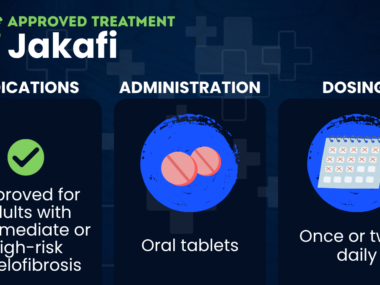
Myelofibrosis treatment mainly aims to reduce spleen size and relieve symptoms. For many people, the first-line treatment includes Jakafi, taken orally twice daily, and other Janus kinase (JAK) inhibitors. These medications block the overactive JAK-STAT signaling pathway, helping reduce spleen size and manage disease symptoms.
However, about 30% of patients do not respond adequately to Jakafi from the start. In addition, other currently approved JAK inhibitors have limited ability to modify the underlying disease, and most patients do not achieve deep or durable responses.
“This gap highlights an unmet need for therapies that address underlying disease biology, extending beyond the management of symptoms and spleen volume,” the researchers wrote. “The current landscape calls for new approaches, including combination therapies with [Jakafi] as the backbone, to potentially improve long-term outcomes in patients with [myelofibrosis].”

Combination therapy did not provide greater overall symptom relief
Navitoclax, being developed by Abbvie, is an oral small molecule designed to block multiple proteins in the Bcl-2 family that help cells survive. In a previous Phase 2 study, dubbed REFINE (NCT03222609), navitoclax was evaluated alone or in combination with Jakafi in patients with myelofibrosis who had previously received Jakafi.
In that study, adding navitoclax to Jakafi improved standard clinical outcomes, including spleen shrinkage and symptom control, as well as biological markers associated with disease modification, such as signs of reduced bone marrow scarring (fibrosis).
To determine whether those benefits extended to patients who had never received any JAK inhibitors before, researchers conducted the Abbvie-sponsored Phase 3 TRANSFORM-1 study (NCT04472598), which enrolled 252 adults. Overall, 125 participants were randomly assigned to receive once-daily navitoclax plus Jakafi, while 127 received placebo plus Jakafi. Patients were followed for a median of 20.3 months.
After 24 weeks of treatment, 63.2% of patients receiving navitoclax plus Jakafi achieved at least a 35% reduction in spleen volume, compared with 31.5% of those receiving Jakafi alone, meeting the trial’s primary goal. Spleen responses also occurred earlier and generally tended to last longer with the combination therapy.
The combination did not, however, provide greater overall symptom relief than Jakafi alone, meaning the study did not meet its main secondary endpoint. The researchers suggested this may be because participants entered the trial with relatively mild symptoms, with Jakafi already providing substantial symptom relief, or because gastrointestinal side effects with the combination therapy may have affected symptom reporting.
These data suggest that some subgroups may derive particular benefit and that meaningful molecular responses could translate into improved survival given sufficient follow-up.
Other clinical outcomes, including anemia response, fatigue, and overall survival, also did not differ significantly between the groups.
However, the combination therapy showed encouraging effects on disease-modifying markers. Compared with Jakafi alone, more patients experienced lessening in bone marrow fibrosis (57% vs. 49%) and achieved at least a 20% reduction in the burden of disease-driving genetic mutations (58.5% vs. 45.5%).
Exploratory analyses also suggested that patients with high-risk genetic features could be less likely to experience disease progression or death with the combination therapy.
“These data suggest that some subgroups may derive particular benefit and that meaningful molecular responses could translate into improved survival given sufficient follow-up,” the researchers wrote, noting that 24 weeks is a relatively short period for evaluating progression-free survival and long-term clinical benefit.
Blood-related side effects were more common with the combination therapy. Severe thrombocytopenia, or low counts of blood-clotting platelets, occurred in 54% of patients receiving navitoclax plus Jakafi compared with 19.2% of those receiving Jakafi alone. Severe neutropenia, marked by low levels of infection-fighting white blood cells, occurred in 40.3% versus 8.8%, respectively. Diarrhea was also reported more often (41.9% vs. 16.8%) in the combination therapy group.
According to the researchers, these side effects were generally manageable and reversible with dose reductions, and no new safety concerns emerged during the study.



Leave a comment
Fill in the required fields to post. Your email address will not be published.